

How To Draw A Feynman Diagram
There are few things more iconic of particle physics than Feynman diagrams. These fiddling figures of squiggly show up prominently on particle physicists' chalkboards alongside scribbled equations. Here'due south a 'typical' case from a previous mail.
The simplicity of these diagrams has a certain aesthetic entreatment, though as i might imagine at that place are many layers of pregnant behind them. The adept news is that's it's really easy to empathize the commencement few layers and today you lot will larn how to draw your ain Feynman diagrams and interpret their concrete meaning.
You lot practise not demand to know whatever fancy-schmancy math or physics to practise this!
That's right. I know a lot of people are intimidated by physics: don't be! Today there will be no equations, simply non-threatening squiggly lines. Fifty-fifty school children can learn how to draw Feynman diagrams (and, I promise, some cool science). Particle physics: fun for the whole family. 🙂
For now, remember of this as a game. You'll need a piece of paper and a pen/pencil. The rules are every bit follows (read these carefully):
- You can draw ii kinds of lines, a straight line with an pointer or a wiggly line:

You lot can draw these pointing in any direction. - Yous may only connect these lines if you accept two lines with arrows coming together a single wiggly line.

Notation that the orientation of the arrows is important! Y'all must have exactly i pointer going into the vertex and exactly one arrow coming out. - Your diagram should merely contain connected pieces. That is every line must connect to at to the lowest degree one vertex. There shouldn't be any disconnected part of the diagram.
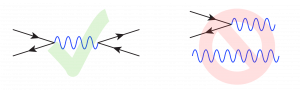
In the image above the diagram on the left is allowed while the one on the right is not since the top and lesser parts don't connect. - What'southward really important are the endpoints of each line, so we can get rid of backlog curves. Yous should treat each line as a shoelace and pull each line taut to make them dainty and smashing. They should be as straight as possible. (But the wiggly line stays wiggly!)

That's it! Those are the rules of the game. Whatsoever diagram you tin draw that passes these rules is a valid Feynman diagram. We volition call this game QED. Take some fourth dimension now to describe a few diagrams. Beware of a few mutual pitfalls of diagrams that exercise non work (tin y'all see why?):

After a while, yous might notice a few patterns emerging. For case, you could count the number of external lines (one complimentary stop) versus the number of internal lines (both ends attached to a vertex).
- How are the number of external lines related to the number of internal lines and vertices?
- If I tell yous the number of external lines with arrows point in, can yous tell me the number of external lines with arrows pointing outward? Does a similar relation hole for the number of external wiggly lines?
- If you go along following the arrowed lines, is it possible to cease on some internal vertex?
- Did you consider diagrams that contain closed loops? If not, practise your answers to the higher up two questions change?
I won't answer these questions for you, at to the lowest degree not in this post. Take some time to really play with these diagrams. There's a lot of intuition you can develop with this "QED" game. After a while, you'll take a pleasantly lightheaded-looking piece of paper and you'll be ready to move on to the side by side discussion:
What does it all mean?
Now nosotros get to some physics. Each line in rule (1) is called a particle. (Aha!) The vertex in rule (two) is called an interaction. The rules above are an outline for a theory of particles and their interactions. We chosen information technology QED, which is brusk for quantum electrodynamics. The lines with arrows are affair particles ("fermions"). The wiggly line is a force particle ("boson") which, in this instance, mediates electromagnetic interactions: information technology is the photon.
The diagrams tell a story about how a set of particles collaborate. Nosotros read the diagrams from left to right, so if you take upwards-and-downward lines you should shift them a footling so they slant in either direction. This left-to-right reading is important since it determines our estimation of the diagrams. Matter particles with arrows pointing from left to right are electrons. Thing particles with arrows pointing in the other management are positrons (antimatter!). In fact, yous tin can think about the arrow as pointing in the management of the flow of electrical charge. Equally a summary, we our particle content is:
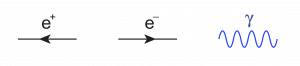
(e+ is a positron, e- is an electron, and the gamma is a photon… think of a gamma ray.)
From this we can make a few important remarks:
- The interaction with a photon shown to a higher place secretly includes information virtually the conservation of electric accuse: for every arrow coming in, there must be an pointer coming out.
- But wait: we can too rotate the interaction so that information technology tells a unlike story. Hither are a few examples of the different ways one can interpret the unmarried interaction (reading from left to correct):

These are to be interpreted every bit: (i) an electron emits a photon and keeps going, (2) a positron absorbs a photon and keeps going, (3) an electron and positron annihilate into a photon, (4) a photon spontaneously "pair produces" an electron and positron.
On the left side of a diagram nosotros have "incoming particles," these are the particles that are about to crash into each other to do something interesting. For example, at the LHC these 'incoming particles' are the quarks and gluons that live inside the accelerated protons. On the right side of a diagram we have "outgoing particles," these are the things which are detected after an interesting interaction.
For the theory in a higher place, we can imagine an electron/positron collider like the the old LEP and SLAC facilities. In these experiments an electron and positron collide and the resulting approachable particles are detected. In our unproblematic QED theory, what kinds of "experimental signatures" (outgoing particle configurations) could they measure? (e.g. is it possible to have a signature of a single electron with two positrons? Are at that place constraints on how many photons come out?)
So we see that the external lines correspond to incoming or outgoing particles. What about the internal lines? These represent virtual particles that are never direct observed. They are created quantum mechanically and disappear breakthrough mechanically, serving just the purpose of allowing a given prepare of interactions to occur to allow the incoming particles to turn into the outgoing particles. We'll have a lot to say about these guys in future posts. Here'due south an instance where we accept a virtual photon mediating the interaction between an electron and a positron.
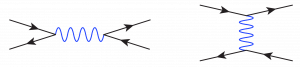
In the get-go diagram the electron and positron annihilate into a photon which then produces another electron-positron pair. In the second diagram an electron tosses a photon to a nearby positron (without ever touching the positron). This all meshes with the idea that force particles are only weird quantum objects which mediate forces. However, our theory treats force and matter particles on equal ground. We could draw diagrams where there are photons in the external state and electrons are virtual:
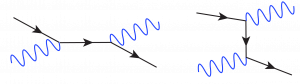
This is a process where lite (the photon) and an electron bounce off each other and is chosen Compton handful. Note, by the way, that I didn't bother to camber the vertical virtual particle in the 2d diagram. This is because it doesn't affair whether we interpret it as a virtual electron or a virtual positron: we tin can either say (1) that the electron emits a photon and and so scatters off of the incoming photon, or (ii) nosotros tin can say that the incoming photon pair produced with the resulting positron annihilating with the electron to form an outgoing photon:

Anyway, this is the basic thought of Feynman diagrams. They permit u.s.a. to write down what interactions are possible. Nosotros will see afterwards that in fact there is a much more mathematical estimation of these diagrams that produces the mathematical expressions that predict the probability of these interactions to occur, and then at that place is actually some rather complicated mathematics "under the hood." However, only similar a work of art, it's perfectly adequate to capeesh these diagrams at face up value every bit diagrams of particle interactions. In subsequent posts nosotros'll develop more techniques and employ this to talk about some really interesting physics, just until and so let me shut with a quick "frequently asked questions":
- What is the significance of the ten and y axes?
These are really spacetime diagrams that outline the "trajectory" of particles. By reading these diagrams from left to right, we translate the 10 axis every bit time. You can call back of each vertical slice as a moment in time. The y centrality is roughly the space management. - Then are you telling me that the particles travel in direct lines?
No, but it's like shooting fish in a barrel to mistakenly believe this if you take the diagrams too seriously. The path that particles take through actual space is determined not merely by the interactions (which are captured by Feynman diagrams), but the kinematics (which is not). For example, one would nevertheless have to impose things like momentum and energy conservation. The point of the Feynman diagram is to understand the interactions forth a particle'due south path, non the actual trajectory of the particle in infinite. - Does this mean that positrons are just electrons moving backwards in time?
In the early days of quantum electrodynamics this seemed to be an idea that people liked to say once in a while considering it sounds slap-up. Diagrammatically (and in some sense mathematically) one can take this estimation, just information technology doesn't really buy you annihilation. Among other more technical reasons, this viewpoint is rather counterproductive because the mathematical framework of quantum field theory is built upon the idea of causality. - What does it mean that a set of incoming particles and outgoing particles can accept multiple diagrams?
In the examples above of ii-to-2 scattering I showed two different diagrams that take the in-state and produce the required out-state. In fact, there are an space fix of such diagrams. (Can you draw a few more?) Quantum mechanically, ane has to sum over all the different ways to get from the in state to the out state. This should sound familiar: information technology's just the usual sum over paths in the double slit experiment that we discussed before. We'll accept plenty more to say about this, just the thought is that ane has to add the mathematical expressions associated with each diagram merely like nosotros had to sum numbers associated with each path in the double slit experiment. - What is the significance of rules three and 4?
Dominion 3 says that we're merely going to care about one item chain of interactions. We don't care well-nigh additional particles which don't interact or additional independent bondage of interactions. Rule 4 just makes the diagrams easier to read. Occasionally nosotros'll have to depict curvy lines or even lines that "slide nether" other lines. - Where practice the rules come from?
The rules that we gave in a higher place (chosen Feynman rules) are essentially the definition of a theory of particle physics. More completely, the rules should also include a few numbers associated with the parameters of the theory (e.g. the masses of the particles, how strongly they couple), simply we won't worry virtually these. Graduate students in particle physics spent much of their starting time year learning how to carefully extract the diagrammatic rules from mathematical expressions (and then how to utilize the diagrams to do more than math), but the physical content of the theory is most intuitively understood by looking at the diagrams directly and ignoring the math. If y'all're really curious, the expression from which ane obtains the rules looks something like this (from TD Gutierrez), though that'due south a deliberately "scary-looking" formulation.
Nosotros'll develop more intuition about these diagrams and somewhen become to some LHC physics, but hopefully this will get the ball rolling!
That's all for now!
–Flip Tanedo, for the United states/LHC Web log.
[Every bit an aside, a special 'hello' to anybody who reads these posts from the 'Large Hadron Collider' Facebook folio. Contrary to some conventionalities, the LHC didn't become sentient and start a Facebook blog. Check out the U.s.a./LHC Web log homepage for more information nearly the physicists who write these posts! PS, while I occasionally browse the Facebook comments, I'm more likely to respond to comments posted to the actual blog folio.]
Tags: Feynman diagram, Feynman rule, particle physics, QED

Source: https://www.quantumdiaries.org/2010/02/14/lets-draw-feynman-diagams/
Posted by: gordonlievaight.blogspot.com
0 Response to "How To Draw A Feynman Diagram"
Post a Comment